Client Portal
 Enterprise AI
 Agentic Enterprise Builder
 Secure Cloud Foundation
 Google Workspace Launch Pad
 Always Ready Resilience
 Blog
Blog Whitepapers & eBooks
 Events
 Partnerships
 Case Studies
 Company
 Careers

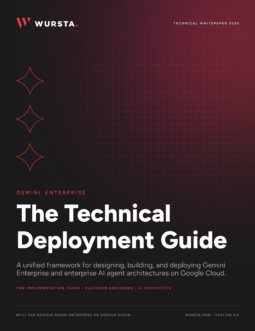
Gemini Enterprise Technical Deployment Guide
Everything your team needs before Stage 0.
The guide is organized in two parts. Part 1 resolves the strategic questions that determine whether a deployment succeeds — how work is defined, framed, and governed. Part 2 is the stage-by-stage implementation manual, from an empty GCP project through a monitored agent ecosystem.
◆
◆
◆
◆
Download the Technical Deployment Guide
Fill out the form to get instant access.
Deployments fail on structure, not on models.
To deploy Gemini Enterprise successfully, an organization must resolve two Manager Problems — workflow and technical design at the team level — and one Company Problem — security and architectural standards at the enterprise level.
Definition of work
Breaking role-based descriptions into modular, task-based workflows.
AI framework for the work
Selecting and implementing the programmatic execution frameworks.
Enterprise standards vs. personal tools
Setting security boundaries between personal use and governed systems — and choosing the platform that scales beyond individual lifecycles.
Work backward from the outcome.
Rather than documenting step-by-step tasks, work backward from the expected business outcome of a role — then measure what the agentic version costs against the manual baseline.
Vendor validation time once the outcome is deconstructed into agentic steps.
of common incidents auto-triaged — freeing staff for deep architectural work instead of repetitive triage.
token-cost reduction from context caching on datasets that are read frequently but updated rarely.
An implementation manual, not an overview.
Every step follows the same pattern: exact instructions, copy-ready configuration, then best practices — console paths, gcloud commands, IAM roles, JSON policies, and BigQuery queries.
From an empty GCP project to a measured agent ecosystem.
Phase −1 establishes stakeholder alignment and the architectural blueprint. Three stages execute against it.
This guide has a companion.
Wursta’s Gemini Enterprise Adoption & Governance Guide. The two are concurrent, not sequential. This technical guide’s Stage 0–2 runs inside the Govern, Enable, and Measure phases of the adoption guide — the technical build and the change-management program happen at the same time, on the same engagement.
This guide covers how Gemini Enterprise is built and secured; the companion covers how an organization adopts it and governs it for durable value.
Built for the teams doing the build.
Implementation Teams
Platform Engineers
AI Architects
We don’t ship tools. We ship outcomes.
Wursta deploys Gemini Enterprise end to end — discovery, architecture, governance, agent builds, and the measurement layer that proves the value. Talk to us before Stage 0.