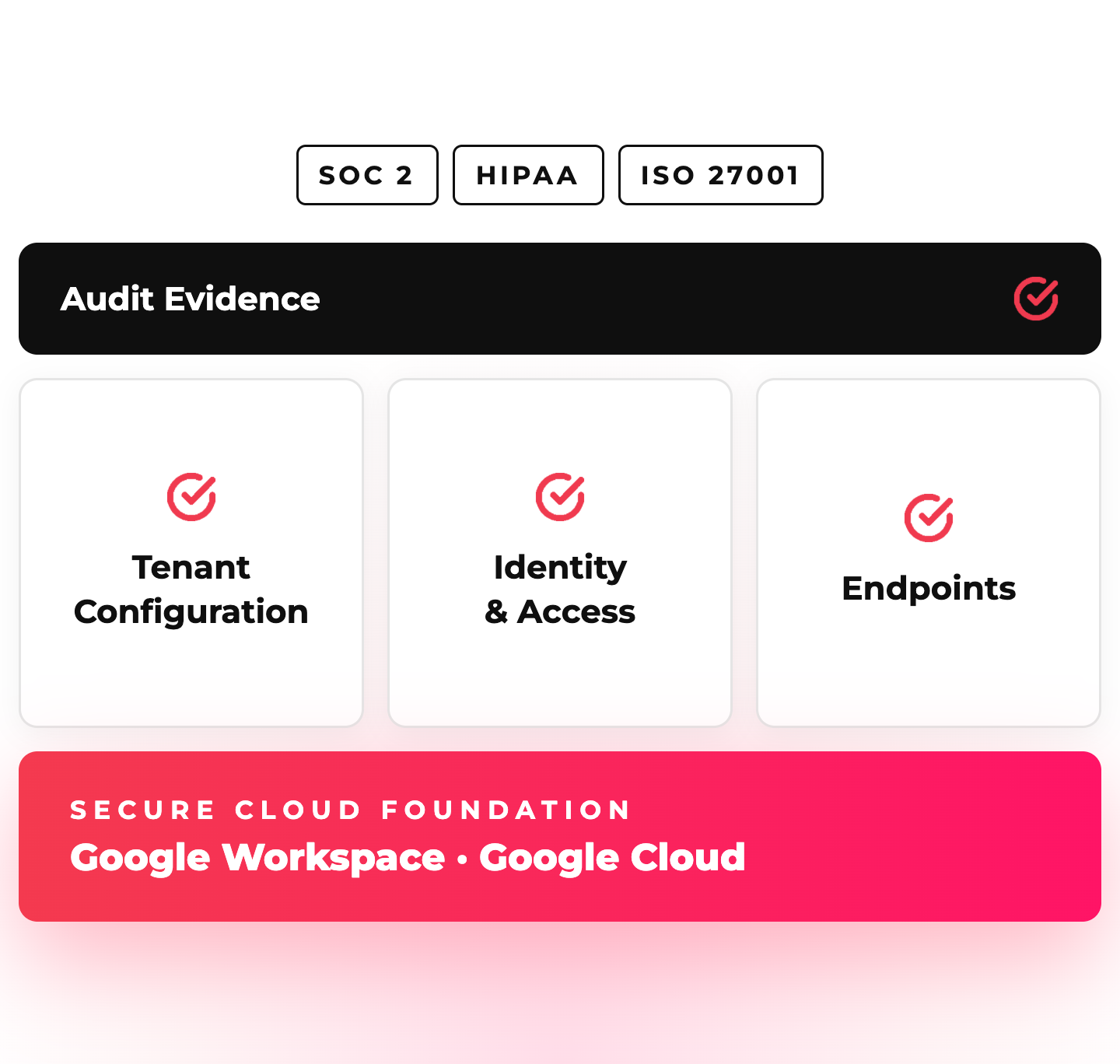
Secure Cloud Foundation Beyond the Shared Responsibility Model: Establish Continuous, Audit-Ready Security Across Google Cloud & Google Workspace

Your auditors don't accept "it depends." Stop assuming native Google configurations guarantee 100% compliance. Move from one-off point audits to real-time posture visibility and fractional executive security leadership.

Schedule a 3C Security Assessment Consultation

No-risk engagement: 100% of your assessment fee credits forward directly toward your first year of continuous monitoring.

The Blind Spot in Enterprise Google Deployments

Migrating to Google Workspace and Google Cloud Platform (GCP) delivers unmatched scale, but it does not absorb your regulatory liabilities. Under Google’s Shared Responsibility Model, Google secures the underlying global infrastructure, physical data centers, and hypervisor layer. Configuring access privileges, safeguarding identities, preventing exfiltration, and enforcing regulatory boundaries remains exclusively your legal responsibility.

For organizations navigating SOC 2 Type II, HIPAA, ISO/IEC 27001, GDPR, or DORA, relying on out-of-the-box defaults creates dangerous compliance drift. Drive sharing links left open to external domains, unvetted Google Workspace Marketplace add-ons with elevated OAuth scopes, and stale IAM service account keys quietly erode your security posture between annual audit cycles.

Who secures what
CUSTOMER · TENANT CONFIGURATION
  • Enforcing regulatory boundaries
  • Preventing exfiltration
  • Safeguarding identities
  • Configuring access privileges
GOOGLE · PROVIDER INFRASTRUCTURE
  • Hypervisor layer
  • Physical data centers
  • Underlying global infrastructure

Tenant configuration is where qualified SOC 2 opinions and enforcement actions originate. This is the layer the Secure Cloud Foundation assesses, monitors, and governs. Google's SOC 3 and ISO reports attest to these layers only. They do not certify how your tenant is configured.

Why Point-in-Time Audits Fail the Modern Enterprise

Risk-conscious leaders cannot afford to treat cloud compliance as an annual scramble for evidence. Relying on periodic checklists and reactive manual reviews produces three critical points of operational failure:

  1. The Evidence Collection Deficit

    When regulators or enterprise prospects demand verifiable proof of NIST SP 800-53 Control AC-6 (Least Privilege) or audit log immutability, engineering teams spend hundreds of billable hours extracting raw logs across BigQuery, Google Vault, and the Security Investigation Tool (SIT).

  2. Silent Workspace Exfiltration Vectors

    Modern insider risk rarely looks like an external breach. It surfaces through rogue OAuth app authorizations, unmonitored browser extensions, and over-permissive Drive inheritance rules that bypass traditional perimeter defenses.

  3. Continuous Configuration Drift

    A DevOps engineer temporarily disables a VPC Service Control perimeter or creates an unencrypted Cloud Storage bucket during a deployment sprint. Without continuous baseline tracking against CIS Benchmarks, non-compliant configurations remain undetected for months until flagged by an external auditor.

The Journey

Introducing the Secure Cloud Foundation: Assess, Monitor, Lead

The Secure Cloud Foundation provides an integrated operating model that bridges technical configuration, real-time posture surveillance, and board-level risk governance. Rather than selling disconnected advisory hours or shelfware reports, we take you through a structured, three-stage journey designed to leave your team in full control.

PHASE 1 · ASSESS

The 3C Security Assessment

Every engagement begins with the 3C Security Assessment: a rigorous, fixed-fee diagnostic that inspects your actual tenant configuration, identity architecture, and endpoint perimeter against CIS Benchmarks and your mandatory compliance frameworks.

3C Security Assessment deliverables and executive impact
The DeliverableThe Executive Impact
Workspace & GCP Health CheckA forensic configuration review identifying active misconfigurations across Cloud Identity, Google Drive permissions, IAM roles, and VPC networks.
Security & Compliance Risk Assessment (S&CRA)A granular gap analysis mapping your current controls directly against SOC 2, HIPAA Security Rule, and NIST CSF 2.0 requirements.
Chrome Enterprise Premium BaselineEnforcement of browser-level Threat and Data Protection, blocking data exfiltration, unapproved extensions, and credential leakage directly at the user endpoint.
PHASE 2 · MONITOR

Cyberwatch Continuous Posture Management

An assessment establishes your baseline; continuous compliance requires active surveillance. Through Cyberwatch Posture Management, we eliminate audit blind spots by converting complex cloud telemetry into actionable, prioritized operational intelligence.

The Deliverable

A unified, real-time security dashboard providing automated configuration tracking, vulnerability management, third-party vendor OAuth risk profiling, and continuous CIS Benchmark scoring. Cyberwatch Pro extends this capability with integrated Business Continuity Planning (BCP/BCDR) modeling and external attacker-view reconnaissance.

The Executive Impact

Eliminate alert fatigue. Instead of forcing your IT team to decipher thousands of disjointed log events, Cyberwatch translates raw telemetry into clear, prioritized remediation tasks mapped to the exact control criteria your auditors evaluate.

PHASE 3 · LEAD

Fractional CISO (vCISO) Strategic Direction

Tooling without executive judgment creates an illusion of security. Through Wursta's vCISO Retainer Services, enterprise organizations secure veteran cloud security leadership without the cost, overhead, or timeline of an executive hire.

The Deliverable

A dedicated, credentialed security executive embedded directly into your operational rhythm—conducting recurring risk committee sessions, overseeing compliance evidence compilation, and managing auditor inquiries.

The Executive Impact

Bridge the technical-executive divide. Your vCISO translates technical telemetry into board-level risk reporting, represents your security program during high-stakes enterprise vendor reviews, and ensures your governance architecture scales ahead of business growth.

Evaluating an upcoming SOC 2 or HIPAA audit cycle?

Don't discover permissions drift during field testing. Request a confidential discovery sprint to baseline your tenant posture with our security team.

Check Assessment Availability →

Compliance & Trust Framework Alignment

The Secure Cloud Foundation delivers verifiable evidence, automated configuration controls, and administrative policies across Tier-1 compliance frameworks:

Secure Cloud Foundation control coverage by compliance framework
FrameworkControlCoverage
SOC 2 Type IITrust Services CriteriaCC6.1 - CC6.3Logical access enforcement, least-privilege role-based access control (RBAC), and multi-factor authentication (MFA) validation via Cloud Identity Premium.
CC7.1 - CC7.2Continuous vulnerability identification, automated configuration baselines, and infrastructure change monitoring via Cyberwatch.
NIST Cybersecurity FrameworkCSF 2.0GV.OCGovernance oversight and risk tiering supported by vCISO strategic advisory.
PR.DS-1 & PR.DS-2Data-at-rest encryption verification, Client-Side Encryption (CSE) policies, and browser-level Data Loss Prevention (DLP).
DE.CM-1 & DE.CM-3Continuous detection of abnormal identity actions and unauthorized endpoint access.
HIPAA Security & Privacy Rules45 CFR Part 164§ 164.308(a)(1)(ii)(A)Documented risk analysis and vulnerability management workflows.
§ 164.312(a)(2)(iv) & § 164.312(b)Audit controls and automated log management across Google Workspace repositories storing Protected Health Information (PHI).
ISO/IEC 27001:2022A.5.15 · A.8.12 · A.8.16Control Objectives A.5.15 (Access Control), A.8.12 (Data Leakage Prevention), and A.8.16 (Monitoring Activities).

Questions from security & compliance leaders

Does Google's compliance attestation cover our Workspace and GCP configuration?

No. Native cloud service provider attestations (such as Google’s SOC 3 or ISO reports) certify provider infrastructure, not tenant configuration. Under the Shared Responsibility Model, configuring access privileges, safeguarding identities, preventing exfiltration, and enforcing regulatory boundaries remains your responsibility.

What does the 3C Security Assessment inspect?

It is a fixed-fee diagnostic that inspects your actual tenant configuration, identity architecture, and endpoint perimeter against CIS Benchmarks and your mandatory compliance frameworks. Deliverables include a Workspace & GCP Health Check, a Security & Compliance Risk Assessment (S&CRA), and a Chrome Enterprise Premium Baseline.

Is the assessment fee credited toward monitoring?

Yes. Your 3C Security Assessment fee is 100% creditable toward your first-year subscription to Cyberwatch.

What does Cyberwatch Pro add?

Cyberwatch Pro extends continuous posture management with integrated Business Continuity Planning (BCP/BCDR) modeling and external attacker-view reconnaissance.

What happens in the introductory consultation?

A 15-minute scoping discussion with a Senior Cloud Security Architect, an evaluation of your current compliance drivers (SOC 2, HIPAA, NIST, ISO), and a transparent scoping plan for your 3C Security Assessment.

Eliminate Guesswork in Your Google Cloud & Workspace Compliance

An auditor's findings report or an active data spill is the costliest time to evaluate your cloud architecture. Establish verifiable security, defensible audit trails, and fractional executive oversight in a unified, proven journey.