Client Portal
 Enterprise AI
 Agentic Enterprise Builder
 Secure Cloud Foundation
 Google Workspace Launch Pad
 Always Ready Resilience
 Blog
Blog Whitepapers & eBooks
 Events
 Partnerships
 Case Studies
 Company
 Careers

The Clicks-to-Capabilities Shift: How to Safely Scale Automation with Google Workspace Studio

Christopher Hopkins-Ward
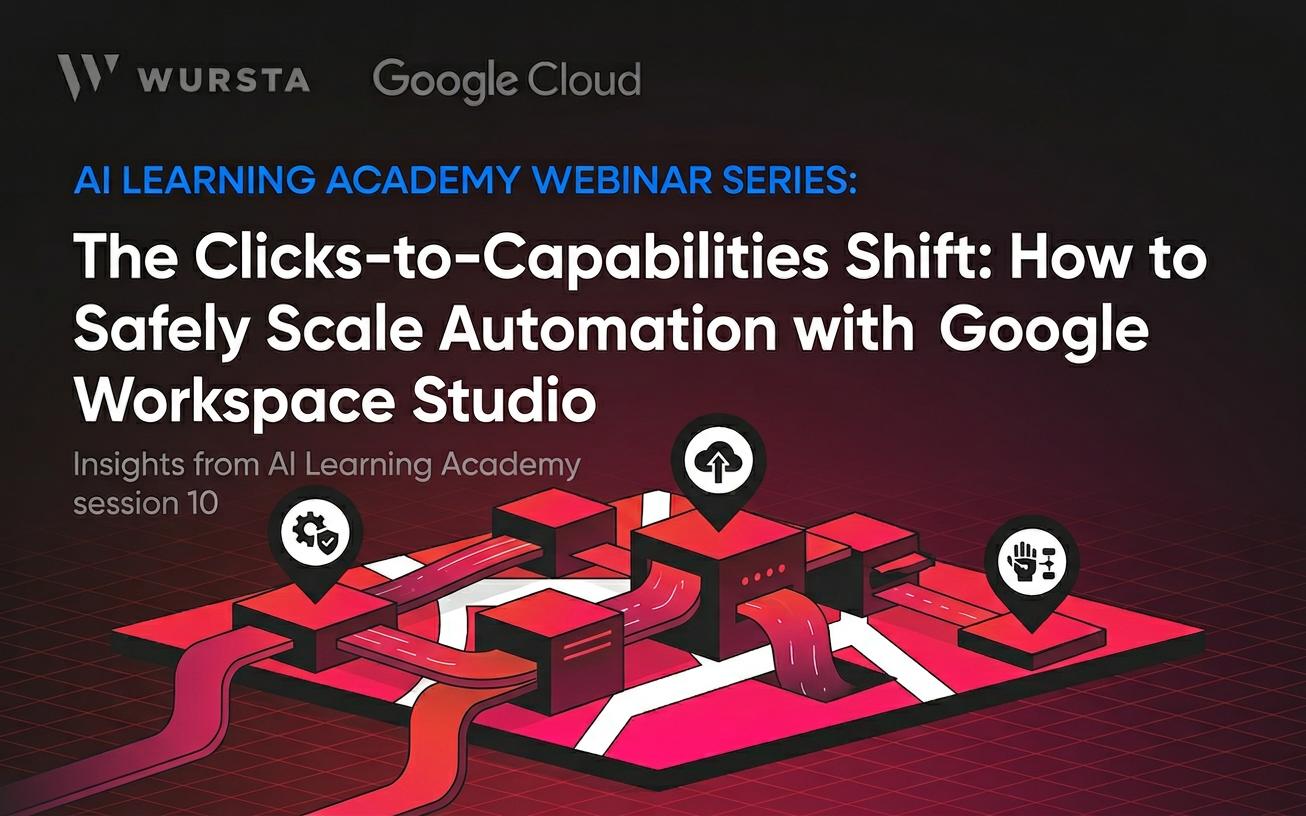
Insights from AI Learning Academy session 10
Eliminating the “Application Tax”
Every day, teams lose valuable hours context-switching. Copying client data from Gmail, pasting it into Google Sheets, drafting customized responses in Google Docs, and sending individual follow-up emails creates a massive manual bottleneck. This routine, often termed the “Application Tax,” is slow, error-prone, and burns out creative minds.
Most organizations are still treating AI as a simple chatbot—manually typing prompts in Docs or Gmail for one-off summaries. But true efficiency requires moving past individual prompting to fully automated, departmental workflows.
Key Insights: The Audience Reality
During our recent AI Learning Academy Session, live polling of operations leaders revealed some eye-opening realities about organizational readiness:
- Familiarity is Low: Almost half of attendees (45.5%) reported “heard the name, haven’t tried it” for Google Workspace Studio, while only 9.1% were actively building flows.
- The Core Bottlenecks: When asked what steals the most time in their week, updating spreadsheets and trackers emerged as the winner, closely followed by email triaging and chasing approvals.
- The Trust Barrier: 50% of the audience admitted they would “need to see it work first” before handing critical tasks to an AI assistant, underscoring that tangible proof of concept is essential for enterprise AI adoption.
The Step-by-Step Build Recap
To overcome the “see it work first” hesitation, a functional 24/7 client response automation was built live in under 15 minutes during our recent AI Learning Academy. Google Workspace Studio uses a simple “if-this-then-that” structure connecting Triggers, AI Reasoning Steps, and Actions.
The Live Build: Gmail to Sheets to Docs
- The Trigger: An incoming email (like a client feedback form) hits a Gmail inbox.
- The AI Step: Gemini immediately analyzes and extracts the core feedback, sorting it logically without manual data entry.
- The Actions: Workspace Studio appends this structured data directly into a Google Sheet tracker. Using the newly updated Loop/Repeat Block, it then automatically triggers the drafting of a customized response in Google Docs (using the official corporate template) and queues a personalized Gmail reply.
What used to take an operator hours of copy-pasting is now executed silently in the background.
Governance Checklist: Scaling Safely
While the ability for non-technical users to build flows is game-changing, it opens the door to “Shadow AI” if left unchecked. A lack of formal framework allows unmanaged automations to expose company data, while locking features down completely stifles innovation.
To safely scale automation, organizations must deploy secure, governed Workspace Studio environments. This involves establishing CISO-approved sandboxes, configuring data loss prevention (DLP), managing agent identities, and instituting role-based security configurations. Proper change management—like Wursta’s Center of Excellence (COE) models and Workspace Kickstarts—ensures teams innovate under strict guardrails.
Ready to Reclaim Your Workweek?
Don’t let manual administrative clicks slow your organization down. If you missed the live session, you can watch the webinar on-demand.
Want a guided walkthrough? Book a complimentary 15-minute Executive Strategy Session to configure your first secure automation sandbox today.