Client Portal
 AI Solutions
 Custom Development
 Cloud Services
 Cyber Security
 Digital Workplace
 Managed Services
 Blog
Blog Whitepapers & eBooks
 Events
 Partnerships
 Case Studies
 Company
 Careers
 FAQ
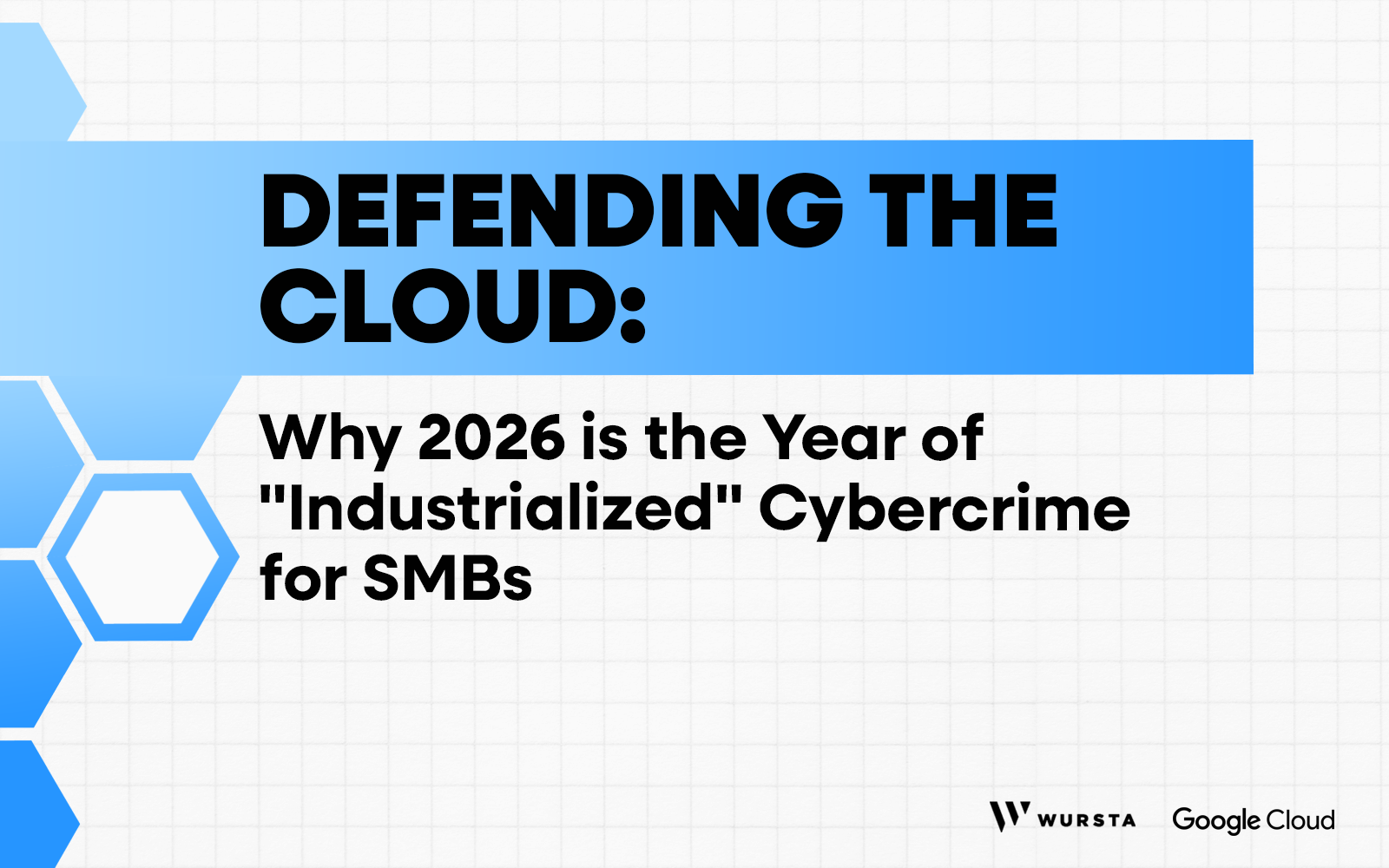
FAQDefending the Cloud: Why 2026 is the Year of “Industrialized” Cybercrime for SMBs

Pete Hoff
For years, Small and Midsized Businesses (SMBs) relied on “security through obscurity.” In 2026, that strategy isn’t just outdated—it’s dangerous. We have entered the era of Industrialized Cybercrime, where attackers prioritize “throughput” over target size, using AI to scan and exploit thousands of businesses simultaneously.
According to the Fortinet 2026 Cyberthreat Predictions, the barrier to entry for cybercrime has collapsed. What used to take a team of elite hackers days can now be executed in hours by automated “cybercrime agents.”
Industrialized Crime isn’t an anomaly; it is the new normal.
The 2026 cybersecurity landscape will be marked by two major trends, according to leading forecasts: the industrialization of cybercrime and the emergence of AI-driven “agentic” threats. Small to Midsized Businesses (SMBs) can no longer rely on “security through obscurity”—the outdated belief that their size makes them safe.
Here is a detailed look at the 2026 threat landscape for SMBs and why your cloud infrastructure has become the primary battleground.
1. The Industrialization of Attacks: You Are Now “Cheap” Enough to Hack
In the past, sophisticated attackers focused on “Big Game Hunting”—targeting Fortune 500s for massive payouts. However, the 2026 outlook shifts the focus to throughput.
According to Fortinet’s Cyberthreat Predictions for 2026, cybercrime has evolved into an industrialized economy. Automation and AI have collapsed the barrier to entry, allowing attackers to scan thousands of SMB networks simultaneously for unpatched firewalls or misconfigured cloud permissions. Attackers are no longer looking for the “biggest” target; they are looking for the fastest path to monetization.
Wursta has observed numerous client losses and cloud bills exceeding $100,000 per incident. This redefines the threat from data theft to resource hijacking (which is an immediate financial crisis). It proves that in an “industrialized” landscape, attackers monetize your infrastructure (via cryptomining or compute theft) rather than just your secrets, turning a misconfiguration into a black swan event that ends a business.
2. The New Cloud Threat: Resource Hijacking and Bill Shock
As noted in the Google Cloud Cybersecurity Forecast 2026, threats against cloud infrastructure are pivoting. Attackers are increasingly targeting the virtualization layer and cloud management consoles for immediate financial gain. There is now a ratio of 82 machine identities for every 1 human identity.
This explains why the perimeter has failed. The sheer volume of “autonomous insiders”—service accounts, bots, and AI agents—vastly outnumbers human employees. This statistic justifies the article’s focus on “Identity is the Perimeter” and explains why static passwords are no longer sufficient: the attack surface has expanded exponentially beyond human oversight
The threats are adapting;
- Cryptomining & Compute Theft: When a Cloud environment, such as GCP or AWS, is compromised, attackers often exploit the breach beyond data theft by provisioning vast computing resources for activities like cryptomining or illicit processing. This misuse frequently results in “bill shock,” a concern we consistently raise with our clients. Often, Financial Operations (FinOps) and the management of billing quotas and kill switches for runaway processes are neglected. Technical teams commonly overlook the critical need to set these boundaries and monitor real-time compute usage.
- The “Shadow Agent” Risk: As detailed by Palo Alto Networks in their 2026 Predictions, the rapid adoption of AI agents (autonomous software that performs tasks) is creating a new attack surface. Employees are connecting unauthorized AI tools to corporate data, creating “Shadow AI” risks that bypass traditional security filters and open new backdoors into your cloud environment.
- Identity is the Perimeter: In 2026, identity stands as the prime target for cyberattacks. A significant trend involves attackers compromising service accounts—privileged software tools—to transform them into “autonomous insiders” capable of executing attacks instantaneously. This threat often materializes when organizations fail to adequately secure tokens and identities while adopting new technologies, such as enabling solutions like Vertex AI Agents in Google. The introduction of these new solutions can inadvertently create security vulnerabilities that demand careful management and immediate attention.
3. Ransomware 2.0: Aggressive Extortion and Supply Chain Pain
Ransomware remains a critical risk, but the tactics have changed. Because companies are getting better at backing up data (and refusing to pay for decryption), criminals have shifted to “multifaceted extortion.” Simply rolling back any ransomware with a recent data restore will not protect you. Nor should that have been the solution either. The implications of a ransomware attack are that your data was compromised as well, requiring you to notify regulators.
As detailed in the 2026 Ransomware and Cyber Threat Report by GuidePoint Security, attackers are no longer just locking your files. If you refuse to pay, they will:
- Harass your clients directly, using your own email systems to spread fear.
- File reports with regulators (like the SEC or privacy commissioners) to alert them of your breach, compounding your legal troubles.
- Target the Supply Chain: SMBs in professional services (Legal, Manufacturing, Logistics) are increasingly targeted not for their own money, but as a “pivot point” to attack their larger upstream partners.
4. The AI Threat: The Rise of the “CEO Doppelgänger”
The days of identifying phishing emails by poor grammar are gone. Generative AI allows attackers to craft flawless, personalized phishing emails at scale.
In 2026, a significant threat will emerge in the form of “CEO Doppelgängers”, AI-powered, real-time deepfakes used for video and audio calls. These tools, as noted in Palo Alto Networks’ predictions, can perfectly imitate executive voices and faces to authorize fraudulent wire transfers, effectively bypassing the security checks of finance teams. This poses a particularly high and immediate financial risk for Small and Midsize Businesses (SMBs) that lack strong, multi-layered verification protocols. The human element is often overlooked as a crucial defense. Organizations must move beyond annual training and continuously educate employees on how to identify these evolving cybersecurity threats.
5. The “Harvest Now, Decrypt Later” Threat
While immediate financial loss is the primary concern, forward-looking SMBs must also consider the “Harvest Now, Decrypt Later” (HNDL) strategy. As noted in recent academic and industry research by Mehrdad Zakershahrak, nation-state actors are stealing encrypted data today with the intention of decrypting it once quantum computing matures. For SMBs holding long-term intellectual property or sensitive client data, this is a ticking time bomb that requires a shift toward crypto-agility.
How SMBs Can Survive 2026
The threats are automated, but your defense cannot be manual. The Global Digital Trust Insights 2026 report notes that only a small percentage of organizations are spending enough on proactive measures.
To avoid the $100k cloud bill and the reputational damage of a breach, SMBs must:
- Lock Down Cloud Identity: Service accounts and cloud permissions must be audited continuously. Static passwords for cloud access are a liability you cannot afford.
- Monitor the Edge: Ensure your VPNs and firewalls are not just running, but actively monitored for the automated scans that precede an attack.
- Validate Your Security: Don’t assume your tools are working. Continuous exposure management is replacing periodic assessments to find gaps before the AI-bots do.
- Elevate Awareness: Annual training is not enough; you must continuously educate employees on how to identify evolving cybersecurity threats.
At Wursta, we have an automated approach to protect your Google Cloud, and it doesn’t have to be expensive or time intensive. Contact us today to audit your infrastructure before the next bill arrives.
About the Author: Pete Hoff
Peter Hoff’s career spans the military, financial services, education, and retail sectors, culminating in his current role as a cybersecurity leader. His professional journey began with a tour in the U.S. Air Force, where he supported communications systems and mainframes. Transitioning to the private sector in the mid ‘90’s, Hoff initially focused on technical support for network and enterprise server systems. His commitment to cybersecurity leadership was cemented with his CISSP certification in 2004 which he hold active today. During his career he’s held numerous technical certifications across networking, server technologies and cloud infrastructure. Hoff has established over a decade-long collaboration with Google on security solutions beginning in the early 2010s.
Hoff served as Director of Information Security for JM Family Enterprises, a $17-Billion automotive retailer, held the role of Chief Information Security Officer (CISO) and Director of Information Security at Pet Retail Brands, and most recently as the Vice President of Global Cyber Security and Risk at Wursta. In this role, he currently leads cybersecurity strategies, authors key insights on topics such as cloud cost control and essential cybersecurity practices, and advocates for risk balanced cybersecurity solutions. His practical expertise is backed by certifications including Google Cloud Associate Cloud Engineer (2022) and CMMC-AB Registered Practitioner, in addition to his Bachelor of Science in Information Technology and Occupational Education from Wayland Baptist University. Throughout his extensive career, Hoff has consistently focused on practical risk management, pioneering innovative threat responses, and building secure organizational foundations.